
Thyroid Disorders in Women Over 30: Symptoms You Shouldn't Ignore
- Phoenix Medical Group of Florida

- Oct 21, 2025
- 6 min read
Women and Thyroid Disorders: Understanding Symptoms, Testing, and Treatment
Approximately 1 in 8 women will develop a thyroid disease or disorder in their lifetime (American Thyroid Association, 2019). Did you know that up to 60% of people with a thyroid problem go undiagnosed? (ATA, 2019). Thyroid disorders are often underdiagnosed or misdiagnosed in the primary care setting. This is because patients often present with symptoms that closely mirror those of other conditions, creating a complex diagnostic landscape. As a result, providers may struggle to make an accurate diagnosis for effective treatment. Conditions, including but not limited to depression, metabolic dysfunction, or even ineffective coping skills with life in general, can paint the same kind of picture as a thyroid disorder."
Primary providers commonly use a word in practice called "unpeeling an onion". What that relates to is a provider thoroughly assessing and addressing a patient's concerns, unpeeling the onion until the core is reached. A provider will then ask more refined follow-up questions to filter out the most likely and the least likely diagnosis. The symptoms being experienced by one patient may not be the same as those another patient may be experiencing; however, they may be overlapping. The initial dialogue between a patient and provider is the most crucial one. That first appointment establishes a trusting rapport and relationship, leading to improved compliance and outcomes with treatments. Although an in-depth dialogue creates a trusting rapport, the patient may forget key symptoms when rushed. Patients should make a brief list of their concerns and symptoms before their appointment to discuss in detail. Providers need to exercise due diligence by asking pertinent questions and encouraging patients to elaborate when needed. In many primary care environments, the typical 15-minute appointments often lead to potential human error. This can cause unnecessary diagnostic tests, unwarranted specialty referrals, and poor outcomes, as patients might not receive an accurate diagnosis and treatment.
Hormonal Imbalance or Normal Aging
In the primary care setting, oftentimes women in their late 30s to mid-40s want their hormones "checked". What is most likely being referred to as "hormones" are estrogen, progesterone, and testosterone levels. Those hormones are very important to evaluate and may be contributing to the presenting symptoms; however, the thyroid gland secretes hormones as well. While it's true that progesterone, estrogen, and testosterone levels decrease as we age, there might be another hormone responsible for the symptoms.
The body is an amazing machine with an inherent ability to automatically perform checks and balances to keep you operating efficiently. Hormone levels are constantly monitored and adjusted based on supply and demand, 24/7. Unfortunately, as we age, this communication between the glands diminishes, leading to a decrease in the secretion of essential hormones needed for our functioning.
With over 20 years of medical experience, I have observed that women often visit for a "yearly exam" reporting fatigue, feeling run down, and weight gain. Typically, a complete blood count, metabolic profile, lipid panel, and TSH are ordered, and sometimes vitamin D levels are checked. Usually, labs and other diagnostic tests are conducted with instructions for the patient to follow up once the results are available. "The question is, why are thyroid disorders so frequently underdiagnosed or not diagnosed at all?" We will discuss and explore some general findings on why this might be happening.

How Thyroid Disorders Affect Women Over 30
How many people have reviewed their labs themselves and then returned for follow-up, being told, 'your labs are normal and so is your thyroid level. First, nothing in life is normal, and second, what lab(s) were ordered to make this determination?" Many patients are told their thyroid is “normal” based only on the levels of the thyroid-stimulating hormone (TSH). TSH testing is great and should be included in the labs, but research shows this can be misleading and not comprehensive for ruling out a thyroid disorder. Up to 15% of patients with normal TSH still have hypothyroid symptoms due to low Free T3 or high Reverse T3 ( For example, Hashimoto’s thyroiditis — the leading cause of hypothyroidism — is confirmed by additional tests like thyroid antibody testing (TPO & TgAb), not just a TSH level alone (ATA, 2019).
In the United States, thyroid disorders rank among the most underdiagnosed medical conditions (ATA, 2023). An estimated 20 million Americans have some form of thyroid disease — yet up to 60% of them are undiagnosed because symptoms are often mistaken for stress, aging, depression, perimenopause, andropause, or poor lifestyle habits, etc. The Thyroid hormones regulate metabolism, energy production, heart rate, digestion, body temperature, calcium, sexual function, sleep, thought patterns, and temperature as they work in tandem with other hormone-secreting glands. (Patil et al.,2024).
Common Symptoms of Hypothyroidism
20 million Americans have a thyroid disorder
Hashimoto’s disease is the #1 cause of hypothyroidism
60% remain undiagnosed or undertreated (ATA, 2023)
Thyroid disease is 8 times more common in women than in men (ATA, 2023)
Risk increases after age 30 and sharply rises after pregnancy or perimenopause.
Nearly 1 in 8 women will develop a thyroid disorder in her lifetime.
Family history and autoimmune disease increase risk.
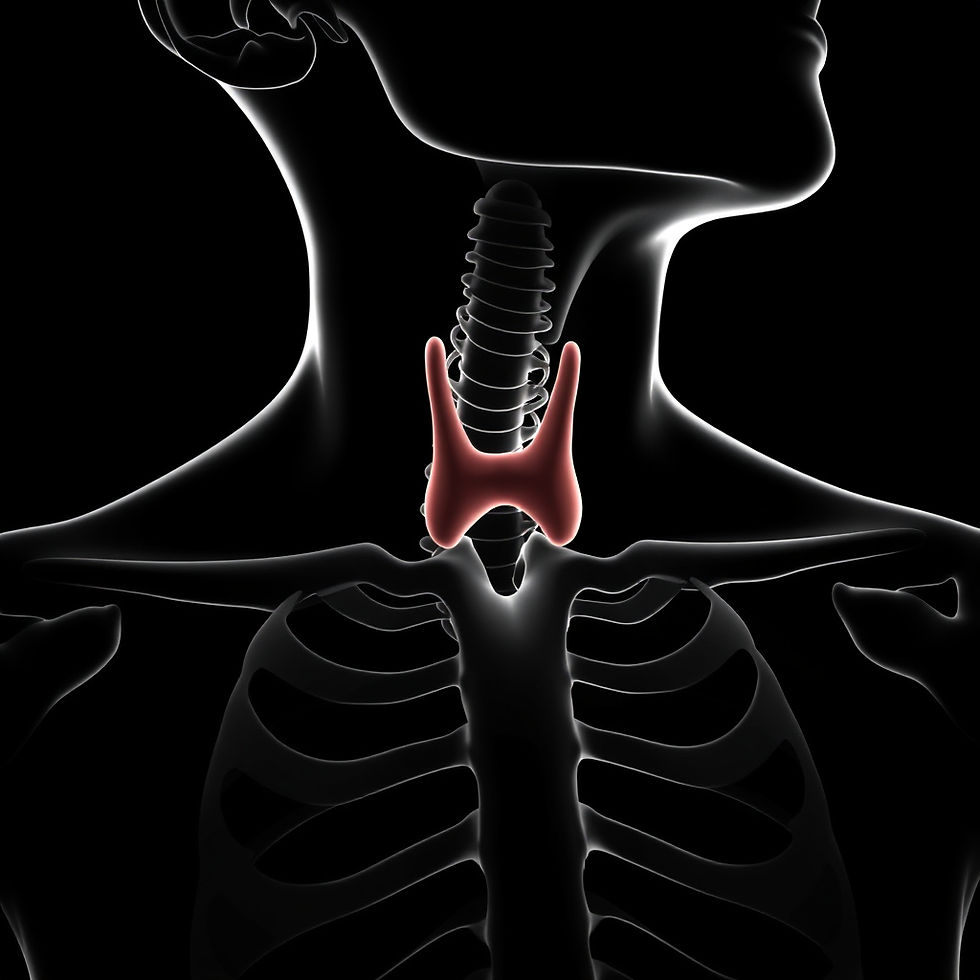
Anatomical model of thyroid gland location
Common Signs of Hypothyroidism in Women
Hypothyroidism is the most common thyroid disorder affecting metabolism and energy. Symptoms include:
Physical Symptoms:
Fatigue & low energy
Weight gain & slow metabolism
Hair loss or thinning
Cold intolerance
Constipation
Dry skin & brittle nails
Mental/Emotional Symptoms:
Brain fog
Depression/anxiety
Memory difficulty
Low motivation
Slowed heart rate
Mood changes
Libido
These symptoms develop gradually and may be mistaken for simply being tired or overworked. Some patients might report experiencing some of the symptoms mentioned above, while others might not. An annual basic lab panel should be conducted to ensure this progressive disorder is detected early. Many individuals do not notice the symptoms or express concerns to their primary healthcare provider until they have suffered for months, if not years.
Personalized Treatment Options
Best For:
Levothyroxine (T4 only): Standard hypothyroidism
NP Thyroid / Armour (T4 + T3): Low T3 symptoms
Synthroid: Autoimmune thyroid disease
Liothyronine (T3): Slow metabolism + persistent fatigue
Selenium, zinc, vitamin D: Hashimoto’s inflammation support
Anti-inflammatory diet
Please consult with your primary provider regarding your diagnosis and discuss options in great detail before taking any new supplements or medications. Some over-the-counter supplements may interfere with your thyroid hormones or interfere with the absorption of thyroid medications when taken orally.
When to Get Your Thyroid Checked
You should get thyroid testing if you have any of these:
Unexplained weight gain
Fatigue even after sleeping
Hair loss or dry skin
Anxiety or depression
Heavy or irregular periods
Cold hands/feet
Slow metabolism
Weakness
Puffy face
hoarse voice
A new nodule felt over the front of the neck.
Comprehensive Testing for Women's Thyroid Health
A complete thyroid panel should include:
TSH
Free T3
Free T4
Reverse T3
TPO & TgAb (thyroid antibodies
Conclusion: Your Health is Our Priority
In today's fast-paced world, understanding your health is more important than ever. At Phoenix Medical Group of Florida, we are committed to providing accurate, evidence-based care tailored to your needs. By choosing us, you take a proactive step towards better health. Visit our website to book your appointment and experience our dedication and expertise firsthand. Your well-being is our ultimate goal. Phoenix Medical Group of Florida is dedicated to ensuring that you receive not only the best medical care but also the peace of mind that comes from knowing your health is in capable hands. By choosing us, you are taking a proactive step towards better health. You will be involved in every step of the process, and we will dedicate as much time as necessary to ensure you fully understand the what, why, when, and where. Your trust is invaluable to us, and we strive to build that trust through transparency, professionalism, and a patient-centered approach. We invite you to visit our website to book your appointment online. Experience firsthand the dedication and expertise that sets us apart. Let us partner with you on your health journey, ensuring you have the information and support you need for a healthier tomorrow. Your well-being is our ultimate goal, and we look forward to assisting you every step of the way.
Citations
American Thyroid Association. (n.d.). General information/Press room. Retrieved October 21, 2025, from https://www.thyroid.org/media-main/press-room/.
Patil N, Rehman A, Anastasopoulou C, et al. Hypothyroidism. [Updated 2024 Feb 18]. In: StatPearls [Internet]. Treasure Island (FL): StatPearls Publishing; 2025 Jan-. Available from: https://www.ncbi.nlm.nih.gov/books/NBK519536/


Comments